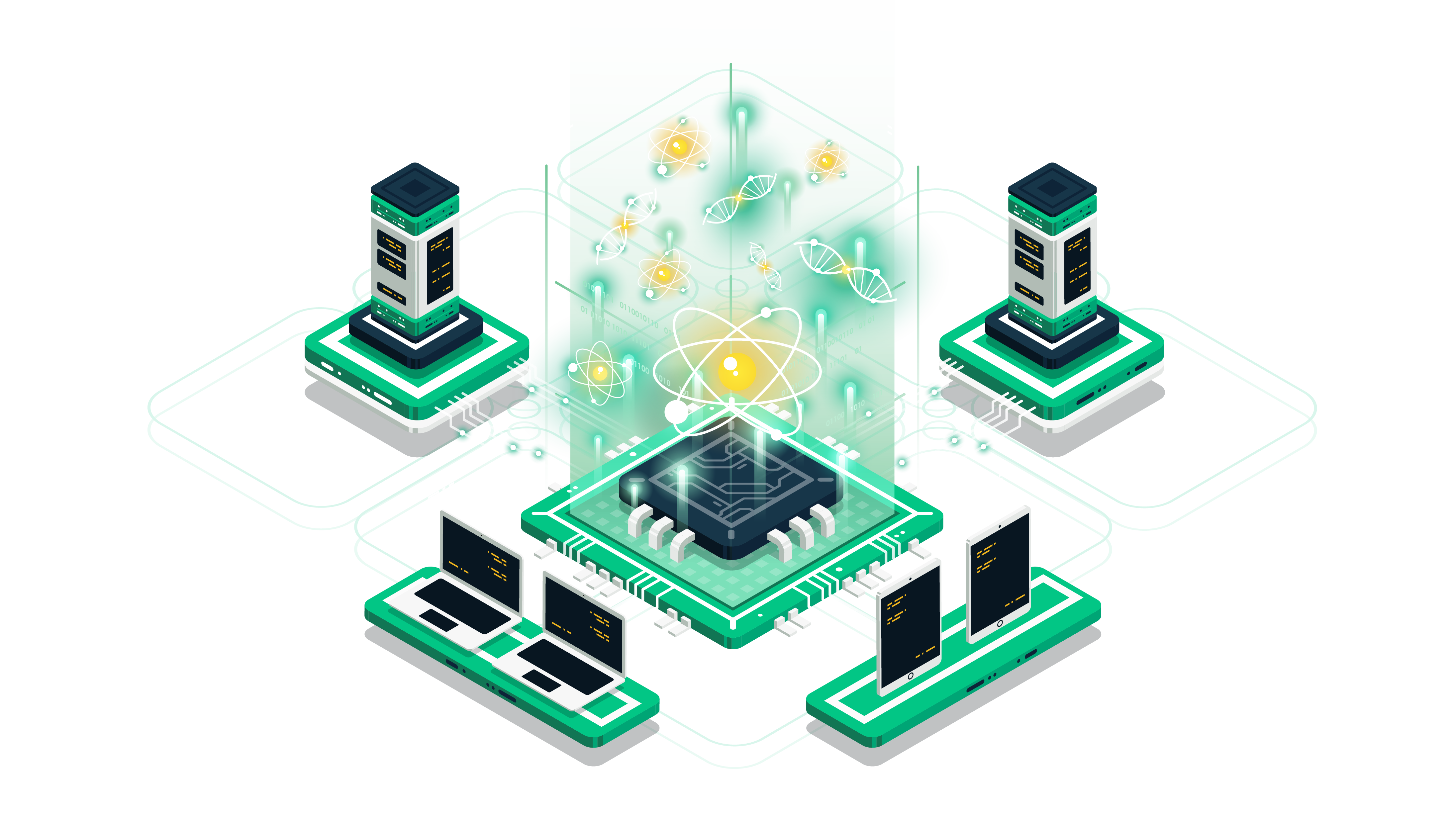
The Distributed Computer realizes the dream of "Write Once, Run Anywhere" with identical implementation. Pooling fungible compute resources together, it increases the availability of all kinds of hardware. The entire network is accessed through the same simple serverless API as your local machines regardless of architecture.
As a global multi-cloud with a unified, secure access point, DCP lets you build for a scale previously limited to large corporations and government.
Access thousands of CPU and GPU cores for high-throughput computing. DCP's serverless architecture lets you scale up and speed up with a few keystrokes.
Traditional microservices and serverless compute lock you into a specific architecture. The Distributed Computer lets you skip across different clouds with the same code.
With identical implementation across different architectures, DCP lets you seamlessly burst to a WAN compute cluster from a local one. Different clusters can also seamlessly combine and separate.
Developers can make the most of applications with embedded distributed compute. The DCP application market provides pre-made software modules as well as SDKs.
DCP's data sharding algorithms mean that sensitive data is sent to verified data centers and kept in secure isolation. Unlike the central cloud, data is not vulnerable at rest.
The Distributed Computer matches tasks with different requirements to the right hardware to ensure that minimal memory and compute capacity goes wasted.
Get US$100 of free compute for your first application on DCP.
Start BuildingThe Distributed Computer unifies everything from the cores on a Raspberry Pi all the way to Tesla GPUs (and even the GPUs on a Tesla car!). Whatever your application, go from experimentation to production with the same API.
Balanced CPU-to-memory ratio, with a vCPU entirely dedicated to your work.
Apps with balanced network & compute needs.
High performance vCPU resources with a modest amount of virtual memory.
Apps with low network and high compute needs.
Powerful vCPU resources with a significant balance of virtual memory.
Apps with high network and low compute needs.
High performance GPU resources on-demand, with virtual memory.
Parallel apps that need graphics processing units.
The Distributed Computer is a network overlay that abstracts and routes data across heterogenous topographies. Every type of connection from Ethernet to 5G is abstracted in the same way to improve ease-of-use.
Every device connected to DCP is given an identifier tag along with data regarding its bandwidth, security, and owner. When a developer deploys their job through the protocol, all data is sent to the central Scheduler, is fragmented, and transmitted to the ideal device to be computed.
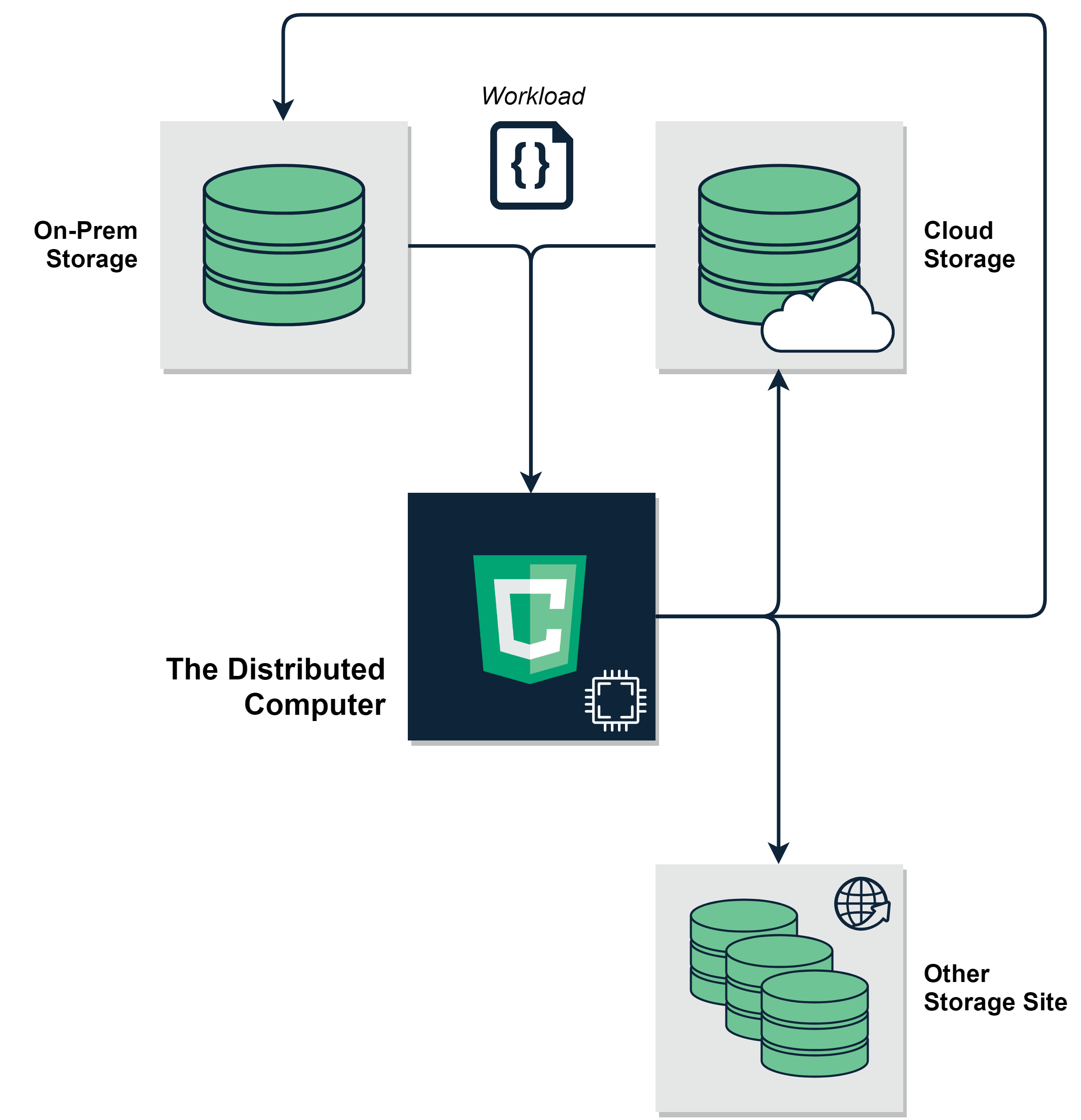
The user of DCP must currently provide their own storage platform to read and write data. This storage can be either on-premises or cloud-based.
All data is transmitted and computed as JSON objects. DCP Workers have no I/O capability with the underlying hardware, and the Scheduler does not store data that passes through it.
The Distributed Computer is a pool of serverless compute resources across various nodes and machines. When a developer initiates a workload through this network, it is characterized and then matched with the appropriate type of hardware.
A single workload can be any size, from a single virtual thread running inside an isolated sandbox to multiple datacentres in different cities. All compute is executed inside the same secure JavaScript V8 engine as local DCP instances.
DCP uses the memory of the underlying infrastructure, which is abstracted away for the developer. A user may however specify a minimum amount of memory that is needed for their application.
DCP instances require almost no memory from the hardware because it uses the lightweight V8 JavaScript engine. Every core on a machine running DCP uses the same overhead, leaving substantially more room for your dataset itself.
Any person or institution can provide compute for the Distributed Computer as easily as signing in to a web account. The array of hardware that can be accessed is vast, ranging from workstation CPUs to the GPUs in a corporate datacentre.
It is possible for providers to build their own private cloud using a DCP Compute Group and also supply the Distributed Computer. Some may also consume resources from other providers during periods of high traffic, or donate spare cycles for non-profit initiatives.
There are multiple levels of security in DCP. Developers can choose to send sensitive workloads to datacentres with appropriate security and location certificates. Compute Groups multiply the cycles available on-premises so sensitive data never has to leave the four walls.
Workloads from different developers running on the same device are secure from each other as well as the hardware providers, because the DCP Sandbox does not permit I/O. In the near future, different degrees of Homomorphic Encryption will also be integrated.
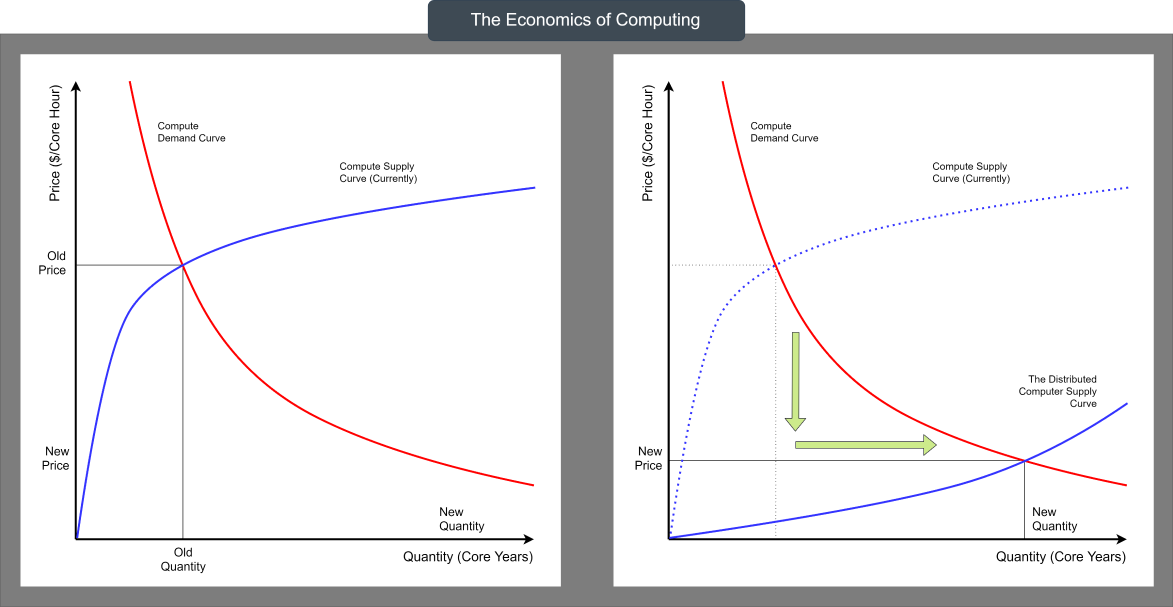
There is tremendous competition for scarce resources at a time when demand is rising exponentially. The Distributed Computer flips the economics of computing so that both the developer and the corporation can win by:
DCP combines public clouds with previously inaccessible private networks like universities to access more cores, all while recapturing huge amounts of wasted cycles. No cloud is as powerful as every cloud.
Perfect competition is the opposite of a monopoly where price is set by pure supply and demand. Since compute is fungible with DCP, providers are nearly equal from the developer’s point of view and therefore the market is productively efficient.
DCP's scheduling algorithms quantify the true economic costs of compute, and put participants on an equal playing field. Because of this, developers can be confident knowing they are not overpaying while providers are not underselling their infrastructure.
Get US$100 of free compute for your first application on DCP.
Start Computing & Earn!These economic elements can be visualized in the following chart. At present, there is only a small quantity of core years provided at a low price which are primarily reserved for researchers. The vast majority of public cloud CPU and GPU resources are priced high above what most need.
The Distributed Computer encourages low cost providers of compute to run your workloads, and also encourages existing cloud companies to sell excess capacity at a discount. DCP enables all kinds of developers to experiment and scale big.
From hyperparameter searches to bioinformatics and everything beyond, build it on the Distributed Computer.
Interested in learning more about how DCP changes the multi-billion dollar business of computing? Check out our partner, Kings Distributed Systems!
Learn About KDSDistributed Compute Labs partners with several institutions to bring accessible compute to the people who need it.
Please contact the core developer team with details about your project. We may be able to find incredibly discounted or even free hardware for you.
You can join and earn compute as easily as opening a web page. DCP workers operate both through the browser or as standalone Node.js daemons for Linux, Windows, and OS X.
By powering someone else's applications during your hardware's idle period, you could be accelerating your own when you need it most. You may operate on an entirely volunteer basis, or set an amount to cover the cost of your network and compute resources.
DCP does not interfere with core operations on your hardware. You can set it to use only a portion of idle capacity, work only during certain hours, or both.
You can choose which applications to contribute compute power to. Favor computational research from a certain institution, only process Canadian datasets, and more.
DCP measures compute in currency. You can use the value that is accumulated to accelerate your own work on the Distributed Computer, or request a payout to bank or virtual wallet.
Built on open source technology, learn how DCP builds superclusters out of heterogeneous machines.
DCL intuitively incorporates some of the most advanced features of any compute platform. Learn how compute.for() changes everything.